






Prepared by Prof., Dr. Habil. Levitskaia Alla
Within the framework of Section I, research was presented by scholars from 12 countries: Republic of Moldova (28 participants), Ukraine (18), Republic of Belarus (12), Italy (4), Poland (2), Latvia (2), Slovakia (2), Czech Republic (1), Romania (1), Bulgaria (1), Georgia (1), Azerbaijan (1). The total number of participants in the section amounted to 73 researchers.
The largest representation was ensured by the Republic of Moldova (38% of the total number of participants), Ukraine (25%), and the Republic of Belarus (16%), which indicates a high level of scientific activity in Eastern Europe and a significant degree of interstate academic cooperation.
The thematic scope of the presented research covered three key areas:
- Economics and Management: 35 papers;
- Marketing and Tourism: 12 papers;
- Accounting, Finance and Credit: 15 papers.
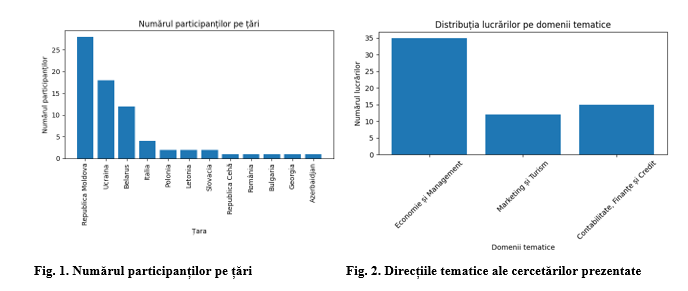
The analysis of the thematic structure shows that the highest concentration of research (over 55%) falls within the field of Economics and Management. This reflects the relevance of issues related to sustainable development, digital transformation, green economy, food and economic security, agricultural sector development, and labor market dynamics.
The “Marketing and Tourism” section demonstrated a strong orientation toward digitalization of marketing, neuromarketing, artificial intelligence, sustainable and wine tourism, territorial branding, and the formation of international country image.
Within the “Accounting, Finance and Credit” section, issues of financial sustainability, tax control, enterprise liquidity, securities market development, research financing, managerial accounting, and digitalization of financial processes were examined.
Thus, the presented research reflects:
- the interdisciplinary nature of modern economic studies;
- a high level of international cooperation;
- an orientation toward sustainable development, digital transformation, and innovation; a practice-oriented character of scientific research.
The work of the section confirmed the relevance of consolidating the scientific potential of Central and Eastern European countries to address contemporary economic challenges and demonstrated the significant contribution of universities and research centers to the development of both applied and fundamental studies.
Section 1.1. Economics and Management
Section 1.1 “Economics and Management” brought together more than 50 researchers who presented approximately 35 scientific papers. The geography of the section covered nine countries: Republic of Moldova, Ukraine, Belarus, Italy, Poland, Czech Republic, Slovakia, Latvia, Romania. Broad international representation ensured a high level of scientific discussion and comparative analysis of economic processes.
The thematic scope was multidimensional and reflected the key challenges of the modern economy. The focus included enterprise competitiveness and strategic management, economic and national security, development of the green and circular economy, implementation of the Sustainable Development Goals (SDGs), transformation of the agricultural sector and agricultural subsidy mechanisms. Significant attention was paid to the introduction of Industry 5.0 technologies, digitalization, and the use of artificial intelligence in managing economic processes. Additional studies addressed labor market development, demographic trends, social inclusion, support for small and medium-sized enterprises, freelancing, and the economics of cultural heritage.
The work of the section demonstrated that economic sustainability is directly linked to innovation, digital solutions, and quality governance. Green transformation and the transition to circular development models are becoming strategic directions of economic policy. The agricultural sector continues to play a key role in food and economic security, while human capital development and inclusive employment are viewed as essential conditions for sustainable growth.
Participants emphasized the importance of developing interstate research projects in green and circular economy, expanding the implementation of Industry 5.0 technologies, strengthening regional labor market support, and enhancing government instruments supporting SMEs and the agricultural sector. Section 1.2. Marketing and Tourism
Section 1.2 “Marketing and Tourism” included 18 researchers presenting 12 scientific papers. Seven countries were represented: Republic of Moldova, Ukraine, Poland, Bulgaria, Georgia, Azerbaijan, Italy.
The main research directions included modern marketing management concepts, marketing research in the context of Industry 5.0, neuromarketing and artificial intelligence, the role of social media in building audience trust, development of event and wine tourism, ecological and sustainable tourism, territorial branding, tourism insurance, and transformation of marketing communications.
During the section’s discussions, it was emphasized that marketing digitalization is a stable and irreversible trend. Neurotechnologies and artificial intelligence enhance the personalization of marketing strategies and consumer behavior analysis. Considerable attention was paid to sustainable tourism as a strategic direction for regional development and to the formation of national image through systematic marketing instruments.
Participants stressed the need to further develop research in digital analytics and neuromarketing, integrate sustainability principles into tourism policy, strengthen international promotion of tourism brands, and develop mechanisms of tourism insurance support.
Section 1.3. Accounting, Finance and Credit
Section 1.3 “Accounting, Finance and Credit” involved more than 30 researchers presenting 15 scientific papers. The section included participants from four countries: Republic of Moldova, Ukraine, Belarus, Italy.
The thematic focus covered financial analysis and enterprise liquidity, state financial control and tax audits, research and innovation financing, securities market development, VAT application in public procurement, managerial accounting in agriculture, accounting for long-term assets, pricing issues, and development of financial instruments.
The section highlighted the growing importance of digitalization in accounting processes and modernization of financial management. Particular attention was paid to adapting financial control mechanisms to modern economic risks, increasing financial reporting transparency, and strengthening enterprise financial sustainability. International case studies concerning the budgetary impact of tax incentives and national capital market development were also discussed.
The section emphasized the importance of harmonizing national accounting standards with international norms, further digital transformation of accounting systems, expanding research in tax policy and financial control, and supporting sustainable capital market development.
Resolution of Section I
- To intensify interstate scientific cooperation in sustainable development, green and circular economy, digital transformation, and innovative management.
- To expand the implementation of digital technologies, artificial intelligence, and Industry 4.0–5.0 solutions in the economy, marketing, enterprise management, accounting, and financial control.
- To promote the transition to sustainable and environmentally oriented development models, including support for green economy, resource efficiency, and energy efficiency.
- To enhance enterprise competitiveness, particularly in agriculture and SMEs, through improved strategic management and government support mechanisms.
- To strengthen the integration of sustainable tourism principles and territorial branding into national and regional development strategies.
- To improve accounting systems and financial control through continued harmonization with international standards and increased reporting transparency.
- To develop capital markets and financial instruments that foster investment activity and long-term economic stability.
- To support human capital development, including digital competencies, professional training, social inclusion, and employment of vulnerable groups.
- To expand the use of modern marketing tools, including neuromarketing, digital analytics, and omnichannel communications.
- To enhance financial and digital literacy among specialists, students, and entrepreneurs.
- To develop applied research aimed at addressing current socio-economic challenges at regional and national levels.
- To strengthen cooperation between academia, business, and public authorities in shaping effective economic policies and sustainable development strategies.