






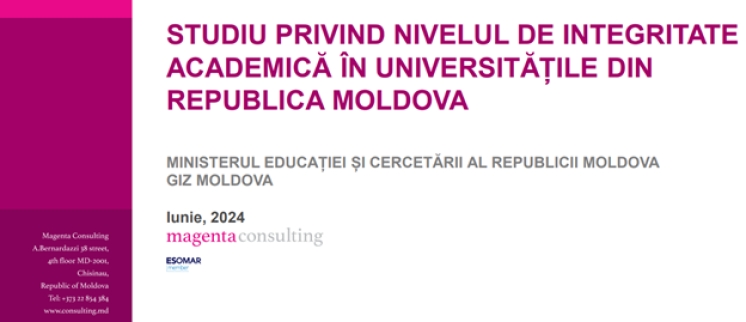

In the Republic of Moldova, seven higher education institutions launched on June 3, 2024, an information campaign "Zero Tolerance for Corruption in Universities". The aim of the campaign is to reduce the scale of this phenomenon in universities through internal mechanisms promoting integrity. The decision was made by the administrations of the seven educational institutions after analyzing the data of a comprehensive study on the level of academic honesty, conducted for the first time in the universities of the Republic of Moldova. The study showed that over 46% of respondents would recommend their friends or acquaintances to study at the university where they are students, compared to 13% who would not recommend it. At the same time, 58% of respondents are fully satisfied with the educational materials prepared by teachers, and 55% give grades from 9 to 10 for the interaction between teachers and students in the educational process, while only 29% of respondents are fully satisfied with the conditions in the cafeterias and only 14% with the conditions in the dormitories. As for the perception of plagiarism, fraud, and corruption in higher education, most surveyed students believe that corruption is a very serious phenomenon in the educational process in universities. According to the majority of surveyed students, the two most serious actions that can occur in higher education are sexual harassment of students and the purchase of university diplomas. Reusing the same text in different works is considered by respondents a less serious violation. "I welcome the decision of university administrations to take note of the results of this study and to start a broad process of improving integrity indicators and reducing the level of corruption in universities. The study confirms existing societal perceptions of deficiencies in ensuring honesty and integrity, as well as a fairly high level of tolerance for fraud, bribery, and other illegal practices. With a quality assurance mechanism, universities can guarantee the quality of education and increase the confidence of young people that they can receive a good university education at home," said Dan Perciun, Minister of Education and Research of the Republic of Moldova (according to moldpres.md/news). The study was conducted from February 2 to March 21, 2024, at the request of the Ministry of Education and Research of the Republic of Moldova and the German Agency for International Cooperation (GIZ). The sample consisted of 4209 students from the State University of Moldova, the Technical University of Moldova, the Academy of Economic Studies, the University of Medicine and Pharmacy "Nicolae Testemițanu", the State Pedagogical University "Ion Creangă", the State University "Alecu Russo" in Bălți, and the State University of Physical Education and Sports. In total, as of the beginning of 2024, these educational institutions had 42,281 students. Based on the study results, universities will approve anti-corruption plans with specific measures to prevent this phenomenon, including the implementation of internal mechanisms for reporting such violations, external monitoring of exams, etc. The Ministry of Education and Research of the Republic of Moldova will repeat the study in 12 months, will procure national software to combat plagiarism, will link the level of university funding to efforts to ensure integrity, will constantly monitor the implementation of plans approved by university senates, and will conduct national educational and awareness campaigns for students and faculty.
You can access the study results by following this link: https://mec.gov.md/sites/default/files/sondaj-universitati_final_3.pdf